
4 Hidden Lies That Keep Christian Women Overwhelmed
Many Christian women feel overwhelmed and exhausted, carrying more than they were ever meant to carry. What looks like being responsible, dependable, or faithful can sometimes be shaped by hidden beliefs that keep us stretched too thin and running on empty. In this article, you’ll uncover 4 hidden lies that keep Christian women overwhelmed and exhausted—and the biblical, boundary-building truths that lead toward rest, stewardship, and wise limits.
It Isn’t Supposed to Be This Hard
It isn’t supposed to be this hard.
My mind was spinning after a long exhausting day at work as I tried to figure out how to carry all my responsibilities without running myself into the ground.
It had always been hard for me to say no. If someone asked me to do something and it was something I knew how to do, I assumed that meant God wanted me to say yes. Saying no felt selfish and wrong.
I looked at all the people around me who seemed to be able to get things done much faster and more efficiently than I could, and comparison held me captive:
I’m the only one who can’t get it all together.
From the outside, I looked good, but inside, I was not doing well, especially the longer this went on. I was stuck in a silent resentment which I did my very best to ignore by telling myself
I shouldn’t be feeling this way.
If you, too, are overwhelmed and utterly exhausted, thinking…
It isn’t supposed to be this hard.
I’m the only one who can’t get it all together.
And if you’re telling yourself…
I shouldn’t be feeling this way…here’s help.
The Hidden Beliefs Beneath Your Overwhelm and Exhaustion
Here are 4 lies that are keeping many Christian women overwhelmed and exhausted—and the boundary-building truths that will help you breathe again.
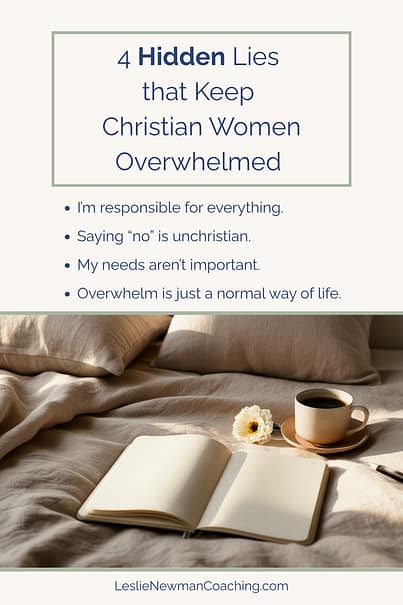 Lie #1: I’m responsible for everything.
This might sound like these unhelpful beliefs:
- If someone asks for help, I’m responsible for meeting the need.
- If I’m able to do it, it’s wrong to say no.
- Other people’s needs are always more urgent than my own limits.
Boundary Building Truth — I’m not responsible for everything; I steward my time and energy so I can serve where I’m truly called.
Before rushing into saying “yes,” it’s important to remember is that your ability to do something isn’t always God’s call. One person can’t take on the weight of too many things without eventually becoming depleted. Making decisions (aka setting boundaries) to protect your energy and capacity is good stewardship. This keeps you healthy so you have enough bandwidth to be fully present for others and yourself (rather than being spread too thin).
When we prayerfully steward our time and energy, we honor God more than we do by saying yes out of pressure, guilt, or people-pleasing.
Scripture to guide you in building better boundaries:
Exodus 18:17–23 (NKJV)— In this passage, Jethro tells Moses, “The thing that you do is not good. Both you and these people who are with you will surely wear yourselves out. For this thing is too much for you you; you are not able to perform it by yourself.”
Jethro encourages Moses to refuse doing everything by himself and appoint others to help him bear the load—focusing Moses’ time and attention on the matters that truly needed his counsel. Jethro was teaching Moses wise limits so the work wouldn’t crush him.
Lie #2 — Saying “no” is unchristian.
This might sound like these unhelpful beliefs:
- If I say no, I’m letting people down.
- A good Christian woman should always be available to help.
- Saying no feels selfish, even when I don’t have the capacity.
Boundary Building Truth — I honor God by saying no when needed, protecting my health and my capacity to serve faithfully.
“No” can be the right thing to say when it keeps you aligned with God’s purposes and protects your well-being and ability to serve others. When guilt nudges you toward an automatic yes to the request, remember Jesus stepped away from crowds, said “no” to people, and made decisions that didn’t match the expectations of others.
Healthy boundaries are about saying YES to God (not NO to people).
Scripture to guide you in building better boundaries:
Mark 1:32-39 NASB — In this passage, the whole city comes after dark and gathers at the place where Jesus was staying. He stays up into the night, healing them a d casting out demons. In the morning, Jesus is gone. Simon and those who were with him searched for Him. When they found him they said to him, “Everyone is looking for you!” Jesus replied, “Let’s go somewhere else to the towns nearby, so that I may also preach there; for this is why I came.”
Jesus didn’t make his decision based on the expectations or desires of others around him. He moved on with purpose because his work there was done. His choices show us this:
Staying true to our calling sometimes means saying no—even when others don’t understand.
Lie #3: My needs aren’t important.
This might sound like these unhelpful beliefs:
- Paying attention to my needs is selfish.
- My needs should come after everyone else’s.
- It’s wrong to slow down when other people are depending on me.
Boundary Building Truth: Caring for my needs is not selfish; it’s wise stewardship that helps me serve others well.
Loving and serving others well flows from compassionate care for yourself. There are times when it’s vital to prioritize your needs in order to protect your capacity and renew your energy. This is healthy self-stewardship, not selfishness. Honoring your needs helps you love others well and keeps you from burning out.
God does not ask you to treat your needs as if they do not matter. Your needs are as important as the needs of others.
Scripture to guide you in building better boundaries:
Matthew 22:37–39 (NKJV) — In this passage, Jesus shares the two greatest commandments, the second of which is, “You shall love your neighbor as yourself.”
Jesus says to love your neighbor “as yourself.” No part of this commandment includes ignoring your needs. Caring for yourself is part of the pattern of love—it’s essential to the pattern of love. Paying attention to your needs is not choosing yourself over everyone else. Healthy love makes room for both compassion for others and compassionate responsibility toward yourself.
There’s a big difference between selfishness and stewardship.
Selfishness says, “It’s all about me.” Stewardship says, “I want to care well for what God has entrusted to me so I can love well.”
Lie #4 — Feeling overwhelmed is just a normal way of life.
This also might sound like these unhelpful beliefs:
- This is just what life feels like for me.
- There’s no real way to slow down.
- Rest will have to wait until everything is done.
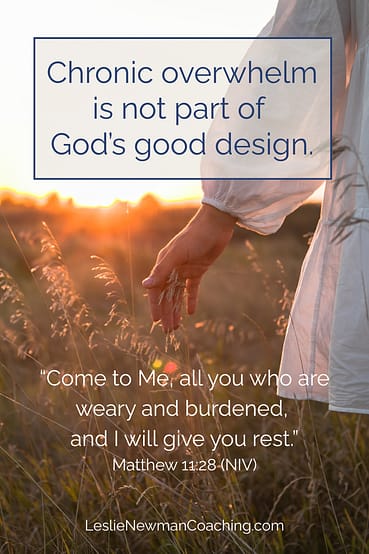
Boundary Building Truth: Chronic overwhelm is not part of God’s good design.
Pushing past your limits can feel normal. It’s easy to ignore your need for quiet, margin, sleep, or emotional recovery because slowing down feels selfish. Rest isn’t laziness. It is a way of honoring the way God designed your human body.
Saying no, leaving space in your schedule, or stepping back before you are completely drained are not selfish choices. They are small acts of stewardship that keep you from becoming too exhausted to show up for the things He put you down here on earth to do.
Scripture to guide you in building better boundaries:
Matthew 11:28–30 (NKJV)— Jesus says, “Come to me all you who labor and are heavy laden, and I will give you rest.”
Jesus meets the weary person with compassion and invites them into rest. He does not ask us to live in a constant state of overload and exhaustion. Rest is a vital part of the Christian life. We don’t have to accept chronic overwhelm as normal.
Setting boundaries, honoring limits, and making room for rest can be faithful responses to Jesus’ invitation.
When We Believe the Lies
When we believe the lies, we end up feeling overwhelmed and exhausted. We may even believe that our overwhelm means that our faith is weak, or that we’re not trusting God enough.
And we blame it on ourselves…
It isn’t supposed to be this hard.
I’m the only one who can’t get it all together.
I shouldn’t be feeling this way.
We hide what’s going on inside, we keep doing more, and we never set the boundaries we so desperately need.
If we continually override our need for rest, quiet, nourishment, or margin, we do not become more loving—we become more depleted.
When We Lean on Boundary-Building Truths
When we lean on Biblical boundary-building truths, we give ourselves permission to set limits—not as selfishness, but as stewardship. Boundaries create space to listen to God, build foundations for better relationships, and set us up for faithful service that lasts. Boundaries help us say yes to what God actually asks of us, rather than yes to every request.
So when those familiar lies grow loud in your mind, answer them with these four grounding truths:
I’m not responsible for everything.
I honor God by saying “no” when needed.
Caring for my needs is not selfish; it is wise stewardship.
Chronic overwhelm is not part of God’s good design.
Tending to your limits, emotions, body, and soul is not selfishness; it is stewardship.
God did not create you as an endless well with no need for rest, replenishment, or care. He made you a whole person with real needs. Honoring those needs is one way you faithfully steward the life He has entrusted to you.
If you’re feeing overwhelmed as a tender-hearted woman, and you struggle to say no, this next step is for you. Subscribe below and receive my People Pleaser’s Guide to Saying No Without the Guilt—a faith-based resource to help you set healthy boundaries with more clarity, peace, and confidence.
This resonates with me. I tend to put off doing things for myself because I have so many other things to tend. Realizing that I must steward myself as well as the tasks and ministry I do for others is important.
I’m glad this resonated. Sometimes it’s hard to find that balance, but it’s so important to do both. Blessings!
MANY Blessings 🙏
Blessings back you, Irene!